This is the tracing version of the set of words I posted earlier. Print and enjoy. You might want to print the rest of the activity pages. For the rest of the pages and instructions on how to use them click here.
Showing posts with label Calligraphy: Fountain Pens. Show all posts
Showing posts with label Calligraphy: Fountain Pens. Show all posts
Saturday, 6 December 2014
Saturday, 22 November 2014
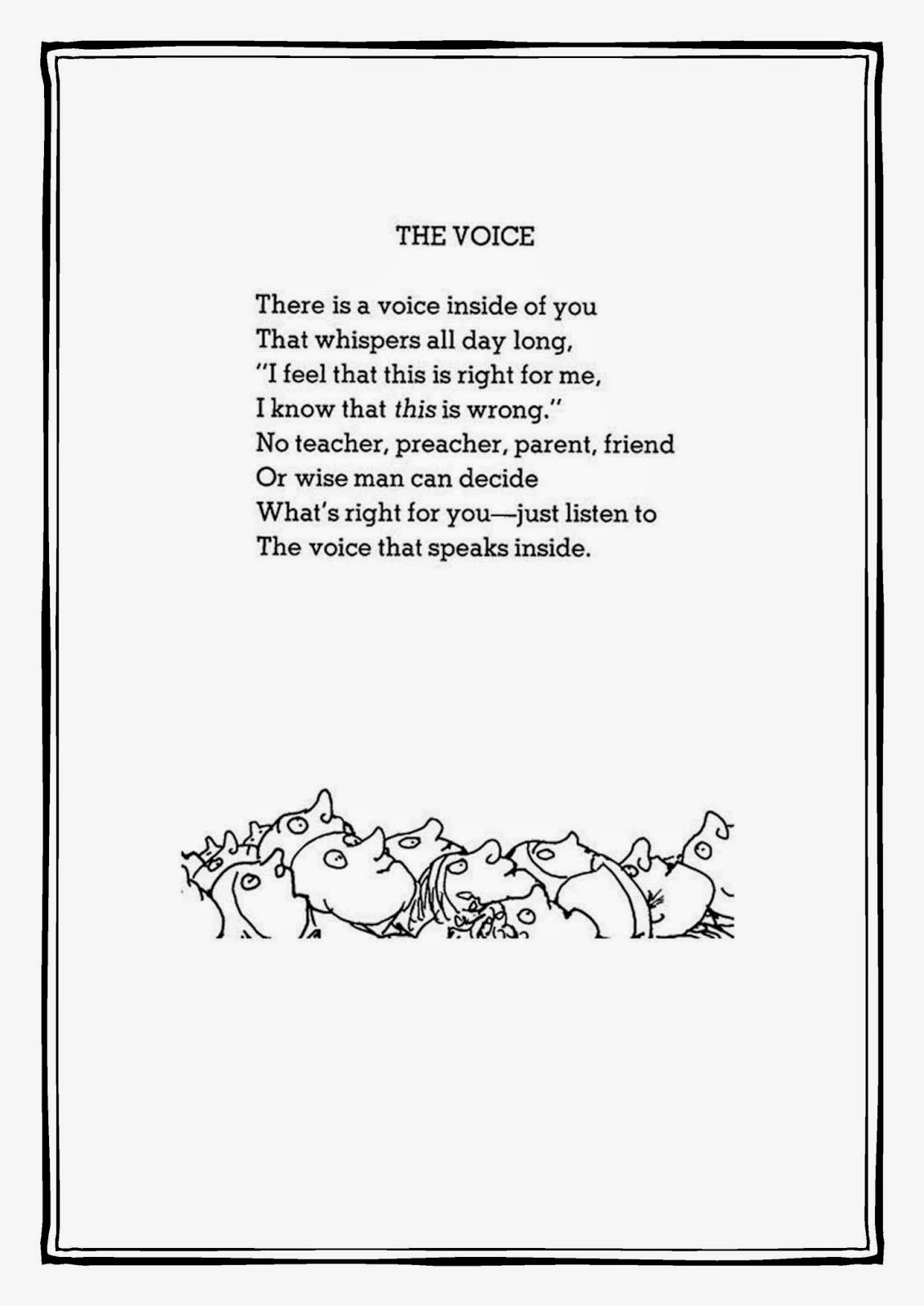
Calligraphy Club: Shel Silverstein Handrwriting Printable Poetry Journal Pages
My love for the poetry of Shel Silverstein cannot be denied by any means. His writing is funny, witty, unconventional and speaks straight through to a child's heart.
This is another Calligraphy club printable, this time including a few poetry journal pages. Just print, ink up your pens and write away!
The voice by Shel Silverstein
Calligraphy Club: Handwriting Worksheet - Christina Rossetti Printable
Another Calligraphy Club Printable, this time featuring a children's poem by Christina Rossetti.
 |
| Christina Rossetti by her brother. Photo via Wikipedia |
The Rainbow
by Christina Rossetti
Monday, 17 November 2014
Calligraphy Club: Printable Handwriting Practice Sheets with a Poetic Twist!
I' ve been using fountain pens since primary school and I have come to realise that those writing instruments have shaped the way I write.

To begin with, as one of my students once told me, fountain pens are like toothbrushes, they are very personal. They adjust the ink flow to the writer's writing angle and pace, and they don't require any pressure, which means that one is able to write in a fluent motion. This means that the fatigue caused by writing for a long time is minimised. Moreover, fountain pens cater for both left-handed and right-handed students, not only because of the adjustable ink flow. Many brands have issued fountain pens for children that offer both left-handed and right-handed grips.


One of the most difficult things to teach a child learning to write is how to hold their pen properly. Fountain pens adress that issue, too. If you don't hold the pen correctly, the ink flow is obstructed and the pen won't write. In other words the writer is "taught" by the pen how to hold it correctly in order for him or her to be able to write.

Using fountain pens increases motivation to write. Many of my students actually HATE writing. A large number of them believe that their handwriting is horrible and that there is no way to fix that. Using fountain pens reshapes this belief, since it helps them transform the appearence of their writing within a couple of weeks. It gives students the satisfaction that they have accomplished something they thought was beyond their reach.

You don't have to spend a fortune in order to buy your child a fountain pen. As a matter of act I advise you not to. There are plenty of quality fountain pens in the market that range from 1,50 to 10 euro and are especially made for children. I also advise that you buy cheap bottled ink to refill the pen. It is cheaper and eco friendly. You might also want to invest in a fountain pen correction pen that will last the whole school year.
So you made your trip to the fountain pen store and got your child a pen... Now what? There are many websites that offer handwriting practice sheets that you can use. I for once prefer to make my own, not only because I can choose the font but I can also play around with the content. In order to help my students get familiarised with poetry and songs that I love, I use poems and songs for my handouts. I have also bought a cheap calligraphy notebook that I give to the students that finish early.
Here is the first calligraphy handout I made for my calligraphy club, featuring a poem by one of my favourite poets: Shel Silverstein. Print and enjoy. There will be more soon.


Wednesday, 3 October 2012
Vintage Alphabet Books Revisited
I have always been a fan of rare, vintage and out of print books, however their cost has never been within my reach. This is why is love Project Gutenberg, an online community dedicated to making rare and out of print books accessible to people. I spend many hours browsing through their catalogues for vintage books I can't find where I live. I read a lot of e-books, not because I prefer them to paperbacks, but because they are easier to find and they definitely cost less. Anyway, today I though of looking through their calligraphy and lettering section and I stumbled upon a collection of antique alphabet books for children. I was amazed by how witty and well made they were, and I thought I should share some of them with you!

My first find was Kate Greenaway's A Apple Pie. It is an alphabet book with a short of a story. Kate Greenaway managed to deliver a new sense of the alphabet. The children learn the letters while compiling, sentence by sentence ,a story. Her beautiful illustrations are witty and colourful.


My second find is Dame Wonder's Amusing Alphabet. The moment I saw the following photo, I just knew I had to make my own alphabet book. Of course it is not going to have that vintage look but I bet it is something my students will enjoy.


The Absurd ABC, has a funny, witty disposition we don't find in alphabet books these days.


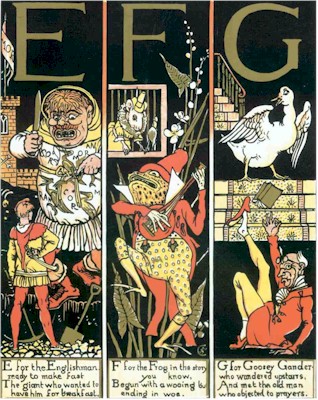

Next I came across with Mother Goose's Nursery Rhymes by Crane, Gilbert, Tenniel, Weir, and Zwecker. It is a compilation of the most popular nursery rhymes but is also offers really breathtaking illustrations. I really like the fact that letters are personified and that aspects of one's personality that would be characterised as negative are depicted with great sense of Humour. They remind me of Edward Gorey.


Finally I came across with a book so aesthetically pleasing that I have to get a copy of this somehow! It is called the Fire Side Picture Alphabet, and it is certainly one of the most beautiful books I have ever seen. The colours are amazing and the text so well written, I wish I was a child when it was first published.


 |
The little sweep has washed his face,
But not as we advise;
For black as soot he's made the soap,
And rubbed it in his eyes.
|
 |
Here's Master Mack presenting fruit,
Of which he makes display;
He knows he'll soon have Lucy's rope,
And with it skip away.
|
 |
Here's Topsy-Turvy, upside down,
The ceiling seems the base;
Reverse the ground and 'twill be found
The things are out of place.
|
All these wonderful pictures from books made me want to start my own alphabet book and card series which is now under way. Of course they are not going to look like that... However given the help of some good people that have made several fonts and released them as public domain fonts, I was able to get started. My first attempt is already finished. All that remains is for me to print them out and get started preparing them for my lessons!
Saturday, 14 July 2012
Printable Reader: What Is Blue?
Here is another Reader we used with my second grade this year. You can save and print the pictures to use with your child. This little book was made for personal use only.


(c) Christina Tsiagli
From Word to Sentence Level
I am supposed to be on holiday, however today I run into some photographs and scans I had made of my second grade notebooks and thought I should share them with you. On Vocabulary That Sticks I wrote about the way my students tried to internalise and retain new vocabulary. One of the most difficult things for beginner learners is to take that vocabulary and use it into meaningful sentences. As I have mentioned before our focus this year was not correct production but recognition of words and their function within sentences.
My second grade students used their notebooks for this. To begin with we used the new words we learnt in funny sentences, that sometimes even made no sense. The point was for the children to get used to the sound of the word and locate it in relation to other, unknown words in a sentence. I loved the way they painstakingly wrote in the little notebooks, depicting what they wrote . Here are a few samples:


We then moved form writing simple sentences to alphabetical order exercises and simple question formation.


We also used our writing to help us improve our reading skills. It was really rewarding for them to be able to read something they wrote on their own.


When it comes to reading skills I think that simple emergent readers and picture books created by me or by the children on their own helped a lot. I created the What is Blue? reader exactly for this purpose. Here are a few sample of the picture class books we used this year.

 |
| What Begins with A? Click Here for a copy of this reader. |

 |
| The Days of the Week |
 |
| Counting Fish |

 |
| Our Classroom Rules! Come Prepared to Learn. |
 |
| Our Classroom Rules: Keep your desk tidy. |
 |
| Our Classroom Rules! Raise Your Hand To Speak. |
 |
| Our Classroom Rules! Don't talk when someone else is talking. |
 |
| Our Colours! |
 |
| What Is Blue? Click Here for a printable copy of this reader. |

Subscribe to:
Posts (Atom)