Showing posts with label Games. Show all posts

Saturday, 20 December 2014

Don't let the pigeon drive the bus! Printable vocabulary memory set.

Here are the additional materials that you can use after or while reading the book Don't Let The Pigeon Drive The Bus!


 These are some of the ways in which you can use the cards:

1. Hand the cards to your child ask them to spot the word in the book. 
2. Give them the Greek word and ask them to find the English one in the book. 
3. Play memory
4. Play Bang
5. Ask them to sort the words into three categories: verb, nouns or adjectives.
6. Rainbow write the words.
7. Write silly sentences.
8. Make word ladders.
9. Make a Word Wall

Book Club: Don't let the pigeon drive the bus!

Don't let the pigeon drive the bus! is one of my favourite books for children, since it addresses many behaviour issues from demanding attitude to anger tantrums. It is the first of many in the series of pigeon adventures. It is funny and witty and perfect for beginner readers. So consider getting one of the Pigeon books for Christmas these holidays, they ensure a good laugh. 


photo via wikipedia 

While you are at it,  click on the book photo to visit the official site and play the games you can find there online. 

Sunday, 7 December 2014

Sight Words Games : Memory Game and Loop Cards Printables

Dolch words are very important to a child learning to read. They are also very hard to teach, because they have to be identified by sight, hence their other names: sight words or high frequency words. Since they make up for the 70-80% of all english printed materials, they are a determining factor for success in reading, especially for beginner learners. 
The following printables are part of the Dolch Word set I have been posting for the past month. 
So go ahead, print, colour and laminate the cards and play with your child or use in class. It is simple, fast and effective. 

Dolch Words Memory Game

Saturday, 6 December 2014

Digraphs Oral Practice

Here are some more fun ways to practice reading digraphs. I found hundreds of videos, so you can use these or find your own online. 

This one is from TurtleDiary.


Digraphs: th Printable Activity Trace and Play Cards

This is the tracing version of the set of words I posted earlier. Print and enjoy. You might want to print the rest of the activity pages.  For the rest of the pages and instructions on how to use them click here.

Teaching Digraphs: th voiced and voiceless Printable Activity

When it comes to phonics, digraphs are one of the most difficult things to teach. It takes alot of practice for a child to learn to identify them, then actually be able to understand the word meaning and finally read them. As teachers we sometimes forget the natural process that is required for our students to produce oral speech. We believe that since we taught something, it must immediately show in our students' output. As most of us know, this is not the case. It takes time and effort for new skills to be internalised to that point, that they can be used by our students.

More specifically, we tend to forget that practice does make perfect and that practice shouldn't necessarily mean controlled writing and reading activities. After discussing this with one of my students' parent, I decided to make a th digraph game to help my students grasp these difficult sounds. It also makes a great Sunday morning game that one can quickly make to play with one's child.  

Friday, 21 November 2014

Dolch Words Printable Memory Game Group 1b

This is the second group of the first 100 dolch words. Just print two sets of each page and colour them in with your child. Practice reading the words with them.


  • Play memory.
  • Play Bang!
  • Ask them to line them up in alphabetical order.
  • Give them a newspaper or book and ask them to find the dolch words in the text.
  • Make a word wall.
  • Ask them to use them in a sentence. (more advanced)

  • Dolch Words, Printable Memory Game Group 1a

    Sight words, Fry words, high frequency words, dolch words. Call them what you might, sight words are very important for young learners when learning to read. According to linguists they enhance reading skills and fluency and give learners the confidence they need in the target language. The fact that they constitute up to 75% of any written text for children is indicative of their importance. For instance you will be surprised to hear that the ten most frequent words in English are the following:

    1. the 
    2. be 
    3. to
    4. of
    5. and
    6. a
    7. in
    8. that
    9. have
    10. I 

    Sunday, 26 October 2014

    Alphabet Printable Board Games: Bang!


    Another simple craft, easy to make and easy to play. I use it to teach the alphabet, vocabulary and irregular verbs to more advanced students. Come to think about it, the ways that one can use this game are endless.


    Materials
    1 box
    paint 
    markers
    cutter
    blank cards

    Instructions

    1. Paint the box whatever colour you like. 


    2. Use your cutter to open a whole in the box. Decorate it whichever way you like. I made mine into another robot!


    3. Prepare your cards. Print, colour and laminate the cards bellow.  You may also want to make your own cards just like I did for the first set I made.


    Click on the pictures and save them to your computer in order to print. 


    I made two sets, one for 2nd graders and one for 3rd. The first set includes words that the children have to recognise and read out loud. The second one includes more difficult tasks, like solving riddles, saying the alphabet by heart, remembering the days of the week or the months, etc. You can also use trivia questions or questions about a book you read with your child. 


    Η Δραστηριότητα της Κυριακής


    • Ο κάθε παίχτης τραβάει ένα φύλλο. Αν μπορεί να διαβάσει την κάρτα την κρατάει, αλλιώς την ξαναρίχνει στο κουτί. Αν τραβήξει κάρτα Bang! χάνει και όλες του οι κάρτες επιστρέφουν στο κουτί. 

    • Για να κάνετε αυτό το παιχνίδι πιο δύσκολο, απλά προσθέστε κάρτες Bang! . 

    • Για περισσότερες κάρτες που μπορείτε να χρησιμοποιήσετε με την κατασκευή αυτή ρίξτε μια ματιά στην κατηγορία Printables

    Saturday, 11 October 2014

    Shel Silverstein's Homework Machine in the EFL Classroom!


    Who wouldn't want a Homework Machine? Shel Silverstein's poem depicts the frustration all of us have felt at least once in their lives. What if you could actually build one and use it at home with your child or even better in class with your students?

    The endeavour is grand but the solution is simple. All you need is a shoe box - or a simple card box-, a cutter and a lot of imagination. I made this Homework Robot to use with my students in class within an hour and believe me Serious Grammaticus, as his name is, became an instant hit among all ages. 

    This is how you can make one of your own. 


    Materials:

    1. card box (a shoe box is the easiest way)
    2. cutter 
    3. glue
    4. markers
    5. blank cards 
    6. thin cardboard 

    Instructions:

    1. Cut two holes on the front of the box, one on the top (input hole) and on the bottom (output). Make them large enough for the blank cards to fit.  


    2. On the inside of the box, make a cardboard pathway connecting the input hole to the output hole. Make the short one first then the longer one. Glue them in place. 


    3. Decorate the box whichever way you like. I made mine into a robot, Serious Grammaticus!


    4. Prepare your cards. One the front side of the card write the questions. On the back side write the answers. The cards will instantly flip when you drop them into the INPUT hole and come out with the answer face up!


    Uses:

    You can use the Homework Machine in many different ways. 

    1. Math
    addition cards
    tables
    subtraction
    multiplication
    division

    2. Language arts
    parts of speech recognition
    plurals
    persons (my brother and I= we, Helen=she,etc.)
    irregular verbs
    spelling: Correct your teacher, error identification
    vocabulary translation 
    dolch words

    Do spend the time making the Homework Machine with your child, I assure you you are going to have a blast. If you do find the time please send me a picture, I would love to see what you came up with!

    Η Δραστηριότητα της Κυριακής 

    Ο Serious Grammaticus, το ρομπότ που μας βοηθάει να μαθαίνουμε παίζοντας, είναι μια εύκολη κατασκευή που μπορείτε να φτιάξετε με το παιδί σας στο σπίτι. Στην τάξη μπορείτε να τον χρησιμοποιήσετε με πολλούς και διάφορους τρόπους, για να διδάξετε από μαθηματικά, γλώσσα (μητρική ή ξένη), ακόμα και ιστορία. Το πιο σημαντικό είναι να δείξετε στα παιδιά σας ότι η φαντασία μπορεί να μεταμορφώσει ακόμα και το πιο βαρετό γραμματικό φαινόμενο σε παιχνίδι. 


    Saturday, 10 November 2012

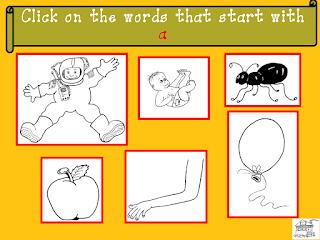
    Free Online Alphabet Matching Game


    Alphabet Matching Game
    Free Online interactive game made using PowerPoint


    It took me a while but I finally made it! I originally used PowerPoint to make the Presentation, then I saved it as an SWF file. I hope you like it! 

    Click on the Start button to enter the game. Once you are in the letter sellection slide, choose a letter to complete the task. To go back to the letter sellection slide, click either on the house image on the bottom right hand corner of the slide, or on the instructions box

    Graphic to display if Flash Player is not available.

    Sunday, 14 October 2012

    Tagxedo Word Clouds, how to use in class.

    When I first run into Tagxedo I was really amazed by the beauty of the images that I could produce, however I had little insight of how to use it in class. I have to admit I gave it a LOT of thought, because my time in class is very limited and tight and I didn't want to use this website just for show - off. I wanted it to be worthwhile. Giving the children something to do with the language they learn is the best way for them to learn, there is no doubt about that. Moreover their ability to use technology is undeniable, it gives them satisfaction and the false idea that they are actually playing, not doing homework. So I came up with a bunch of activities that we can do in class using Tagxedo and I am thinking of gradually introducing them to our lessons, depending on the aim, time availability and of course the children's age. 

    Here are some of the ways you can use Tagxedo to teach vocabulary: 

    Vocabulary Introduction:

    1. While eliciting new vocabulary, ask on of the students to act like your helper. As you elicit, ask the helper to type the new words in Tagxedo, then the whole class decides on the colours, shape, font and theme of your new word cloud. You can even divide your new vocabulary into categories: Nouns, Adjectives, Verbs and so on
    Ways to use the clouds: 
    • You can use these clouds for sentence construction activities, in which a child picks a word they know and the rest of them have to produce a correct sentence using that word. 
    • You can play Red Word Green Word. Divide the class in two groups. Ask one student to act as the game host. The host randomly picks words from the white board, then the teams take turns either producing a correct sentence, or giving the definition of the chosen word. Each team notes down the words they have used correctly. When they make a mistake, they loose five words. The game finishes when all the words are used. 


    2. You can also make the word clouds before the class is introduced to the new vocabulary. In your cloud, include the word definitions in the mother tongue. Ask the children to identify and connect the definitions to the words. 


    Vocabulary homework
    1. You can also use these clouds for vocabulary practice, if you have a website or blog that you can upload your clouds. Give each child some word definitions in their native language. Ask them to go to your page, find the equivalent English word in the cloud and produce a short text or sentences using the words they found. 
    2. Ask the children to make their own clouds at home as copying practice. Typing the words in can be very helpful for them in order to remember the spelling. It would be a good idea to ask them to type the list in Word first, spell check and then copy paste the words in Tagxedo. 
    Depending on the age, you can even ask them to download their clouds and send them to you via e-mail. 

    Here are some word cloud examples I have made for my FCE students using Tagxedo. The words are used can also be found in my Spelling City page, so have a look and tell me what you think! 


    Saturday, 1 September 2012

    Back To School: 2nd Grade Starter Packs

    The summer of 2012 is gone. It has been a weird summer for many of us, and it must be said that I welcome the New School Year with somewhat of a relief. Getting back to business, settling down and enjoying the familiarity of day in - day out routine. Before I come to that though, I must undergo the sometimes painful stage of last year's evaluation. I make a point of writing down my plan for every year. Then somewhere in mid July, I read through it and decide what to keep and what to throw away for next year. Now that this process is over, I can finally get down to business and start preparing my materials for next year.
    When it comes to second grade I am almost ready, as I am not planning to change much from last year. Most of the techniques I tried worked out fine. I am adjusting some things though and I am introducing others. 

    • One of the things I am definitely keeping is my Class Rules. Class rules should be a few, so the children can memorise them easily. They also must be simple and concise. The class rules I am using are the following:


    a. Always raise your hand to speak. 
    Photo via Discovery Education
    Classroom rules 

    b. Don't talk when someone else is talking. 
    Photo via Discovery Education 
    Classroom rules 
    c. Keep your work and space tidy.

    Photo via Discovery Education
    Classroom rules 

    d. Thinking caps on! Always come prepared to learn. 
    Photo via Discovery Education
    Classroom rules   
    e. Treat others the way you want others to treat you.


    Classroom rules

    I compiled these pictures in one chart that I give the children every year. These are ready to be printed out, the moment I find out the number of students I am going to have this year. 


    • The second thing I am keeping is my custom made alphabet chart. This is also printed out and given to the children for the purpose of reference. 

    Alphabet chart that I give out
     to my students in Hill School.
    Copyrighted material. 


    • The above two materials are used in the children's nameplates. Their nameplates are simple A3 pieces of thin cardboard. The children write their names and draw a picture of themselves on one side. The other side contains the class rules and the alphabet chart. We use the nameplates to get a quick lesson start. The moment we get in class the children have to grab their name plates and find their seat. Each child gets a sticker when they seat and raise their hands. The nameplate also helps them define their working space, so we don't have arguments about desk space. When we do exercises the children can easily refer to the alphabet chart on the nameplate without opening books and notebooks. It also helps when it comes to class management, cause the children have the rules before them at all times and we can easily remind ourselves. 


    • Last year I also used writing samples, in order to give the children a sense of progress. In the beginning of each semester I gave out a name practice chart that the children filled in. This also helps to identify cases of dysgraphia and be able to help the child from the beginning. 


    1st Semester Writing Sample
    Σχολή Χιλλ

    Second Semester writing sample.
    It is evident how much this child has improved! 


    This year I am thinking of taking it a step further: 
    Name Writing Practice Sample

    • One new thing I am going to try this year is a homework portfolio, so the children as well as the parents at home, know exactly what they have to do to prepare for the next lesson. I am still working on it, so I am going to show you only a few sample pages. 


    Homework Portfolio Sample
    Ctsiagli (c)
    Σχολή Χιλλ 

    Homework Portfolio Sample
    Ctsiagli (c)
    Σχολή Χιλλ 


    These are some of the things I am definitely using this year. I hope they work as well as they did last year. Every time I get allocated a new class of students, I try to keep an open mind. Some materials work like charm every time, others need changing and others don't work at all. What I try to do is start with a chore plan and then adjust as I go. 

    To see what we did with second grade last year follow the links below:

    Beginner Level 


    Class Books and Readers

    Games


    Friday, 20 July 2012

    Printable Alphabet Games: Memory Letter Tiles


    Summer time may be here, but many people will not be able to go on holiday this year. Our children need simple things to make them happy. Sometimes even a printer and a handful of markers will do. What is more a game that you will make and play with your children is even better. Take the time to make the following printable alphabet game with your child and play with them. It is easy, cheap to make, it is portable and above all educational. 
    It is a classic Memory game. The ways that one can use the following printable are many. Here are a few ideas:

    1. Memory
    Print, colour and laminate the following photos.  Cut each of the letter tiles and place them in a box or bag, so as not to loose them. To play, place all the letter tiles face down. Ask your child to pick one tile at the time and try to match the letters by remembering where they saw the matching letter. Since the tiles include both lower and upper case letters, you can also play around with that: ask the children to match only the lower case or the upper case letters. There are many variations to this one. For more ways to use the letter tiles read the first page of the printable. 

    2. Learning Centre
    This printable can also be used as a learning centre. It is ideal for homeschooling and classroom purposes. Print, colour and laminate as instructed above, place the letter tiles in a box. Use plastic cups or bowls and use the tiles as alphabet manipulatives. Ask the children to short them, by placing all the A's together, all the B's together and so on.
    Variations:
    a. Ask them to find the letters to spell their name as many times as possible.
    b. Write down a few words, like man, can, fan, and pan. Ask the children to find the letters and form the words you wrote.
    c. Ask the children to find all the vowels or all the consonants
    d. Ask the children to make complete alphabet chains.
    e. Randomly pick a handful of tiles. Ask the children to organise the tiles alphabetically.
    As you can see the possibilities are endless, so will be the joy of making a simple game and playing with your child. Give it a go!
    If you have any ideas that you would like to see as a printable here, please let me know and I will do what I can. 


    You might also like:
    Printable Memory Game